


The Top 10 Lies About Guitar Lessons
The Reasons People Can't Learn Guitar
No Musical Talent?
Truth: There are no "Natural-Born" Guitarists
When a guitar teacher (or any other music teacher) can't teach a student, they say he or she has no talent. As if its written in stars. "Talent" really only applies to singers, as some one's vocal sound may well match the tastes of a given era.- This doesn't apply to guitar. Its a tool. Some people are natural athletes. The reason is simple Darwinism. There is a survival advantage in running faster or jumping higher or having sharper eyesight.
- There is no survival advantage in playing guitar, therefore no inborn talent.
- At no point in prehistoric times did any caveman remark "He can make the G chord, he shall be our king."
- Talent means you are good at something. Being good at anything means you learned it the correct way.
Too Old?
Truth: You are not too old to learn guitar.
I have had students begin guitar lessons in their 70's who, to be frank, now OWN all your friends who play guitar.- Little kids have a huge disadvantage in that they don't know what the music is supposed to sound like. Until they start listening to guitar music on their own they really shouldn't be taking guitar lessons (I would suggest singing or drum lessons instead).
- Older students have listened to more music and have done more living.
- If they start out with correct technique and a solid musical framework, students of any age can play well, as long as they know and love the music they want to play,
Too Female?
Truth: "Girls" CAN (and do) Play Guitar
"Girls can't play guitar." If this top ten list were in order of stupidity this would be #1. Women still ask me about this, and to be honest I've heard this so many times from people ranging from 7 year old kids at music schools to professional musicians who should know better. I really hope that this complete and utter fiction invented by insecure male guitar players doesn't survive much longer.
Women have ALL the advantages on the guitar:
- Better fine motor muscle coordination
- Better study habits
- A vocal range better matching the pitch ranges guitar leads are usually played at.
- Don't believe it because its sexist nonsense.
Not Enough Practice Time?
Truth: Make it once a week, You'll Improve
Obviously if you have more time to practice outside of your guitar lessons, and you practice correctly, you can make more rapid progress. But as a guitar teacher the only time I have any control over is class time.
If you show up for an hour a week, you will get better.
I really have no idea the exact amount of time
students practice.
- I do know that without fail for over 20 years, consistent attendance at lessons has equaled success.
My job is to make you the best guitar player possible given your priorities and the time constraints of your life.
Tone Deaf?
Truth:
- You are not tone deaf. If you were it would be obvious. You would talk without vocal inflections. Completely monotone. Like a 50's Sci Fi robot.
- Musical pitch recognition on guitar or in general takes some time, but you will pick it up.
Hands Too Small?
Truth:
- I've taught guitar to many student with tiny hands, and there is no difference in the rate of progress between them and anyone with bigger hands.
- Inability to reach notes in a guitar chord or guitar scale pattern is a result of improper left hand positioning. I will show you exactly how to do it.
No Rhythm / Weak Rhythm?
Truth:
- This is a common problem. But isn't this in part what you are paying to learn?
- It can be taught, and you don't need a metronome,
Left Handed?
Truth:
- There is no disadvantage to being left handed.
Lets be honest here. When first starting out both hands are pretty much equally inept at doing anything on the guitar.
But a big part of the fun of playing guitar is being able to sit in and play in spur of the moment jam sessions. There is always an extra guitar around, there is never a left-handed one.
Not Classically Trained?
Truth:
That's actually a good
thing if you want to play on an Electric or Folk Style
Acoustic guitar. Check out the chart. 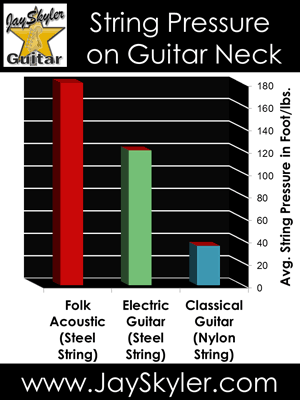
Classical guitar technique is designed for (surprise!) classical guitars. Steel String Guitar technique (also called American Blues technique) is designed for both electrics and our singer-songwriter style acoustics which have steel strings. The difference is the massive differences in string tension. People have often come up to me after live performances, complimented me and said "Your classically trained right?" At which point I'll tell them I'm not but I understand they mean it as a compliment.
The irony is many instructors who teach you to play with classical technique on a steel string are not even classical guitarists, and many of those don't even use the classical technique themselves! Using classical technique on a steel string can be a real good way to mess up your hands!
- Nylon string Technique (for Spanish/Classical Guitars): The thumb is behind the neck with a consistent relationship to the second finger (i.e. middle finger). The strings are sounded with the right hand fingernails with the exception of the pinky.
- Steel String technique (For Electrics and Steel String Acoustics: The left-hand thumb comes over the top of the neck, and leverages all techniques requiring strength, enabling them to be powered by rotating the wrist. The strings are sounded using a pick or less commonly using the right hand fingertips.
If you want to play classical guitar, I'm not the right teacher for you. I teach steel string technique. If you want to learn more, please read my The Two Ways to Play Guitar.
FYI: Any teacher who teaches you to play any differently than they themselves play is incompetent or a fraud. Find a new teacher.
Too Loud for Where You Live?
Truth:
A steel string acoustic can be really loud, especially when you don't want it to be. Electric guitars are practically synonymous with loud! But I'll let you in on a few little secrets:
- Electric Guitars are not very loud without an amplifier.
- Headphone amps are available that sound pretty good and are under $30.
- Electrics and Steel String acoustics use exactly the same technique.
So all you really have to do is start on an electric with a headphone amp, and you will instantly be able to pick and play up virtually any acoustic you see (except Spanish/classical nylon string guitars). Here's an important point:
- You do not need to start on an acoustic!
It's actually a lot easier to start on an electric, a big part of which is the neighbors not distracting you by banging on the walls. The whole you need to start on an acoustic
is really just an old music store scam to sell you two guitars. Everybody believes it, but its just not true. You can read an in-depth explanation of this bit of popular wisdom
here: Should I Start Playing on an Acoustic or Electric Guitar?